Research and Monitoring Activities
The NERRS’ mission states that reserves are protected and managed to afford opportunities for long-term research. The reserve system’s research and monitoring programs provide the scientific basis for addressing coastal management challenges, and thus valuable information about estuarine resources to increase understanding and awareness to a variety of audiences including resource managers, educators, the general public, and other scientists.
Chapter 4: Research and Monitoring Activities
This section covers relevant research and monitoring activities within the Reserve.
Reserves are created to provide a stable platform for long-term research on estuarine conditions and relevant coastal management issues. The NERR System-Wide Monitoring Program (SWMP) delivers standardized measurements of short-term variability and long-term changes in water quality and biological systems, and maps land use and land cover characteristics across all reserves. The effort is focused on three ecosystem characteristics: abiotic characteristics (water temperature, salinity and quality, and weather); biotic characteristics (habitat types and species); and watershed and land use characteristics (land cover and elevation changes). Reserve-generated data meet federal geographical data standards and are available via the Centralized Data Management Office. Reserves also serve as 108 sentinel sites for observing how coastal habitats respond to changing water levels. This program is guided by the reserves’ System-Wide Monitoring Program Plan, the Reserve Habitat Mapping and Change Plan, and Sentinel Sites Guidance. The Reserve System Strategic Plan outlines research objectives to maintain and expand biophysical and socioeconomic monitoring to track environmental change, increase the use of collaborative research to address decision-maker needs, and ensure that scientific, education, and management audiences can use the data, research results, and tools developed by the system.
During focus group meetings prior to Reserve designation, the Indigenous Peoples and Local Communities (IPLC) and the co-management partners identified the following research needs for the Heʻeia NERR, which was incorporated into our Reserve Strategic Plan:
- Establish baseline environmental conditions of the ahupuaʻa of Heʻeia that can then guide future research and monitoring efforts at Heʻeia NERR, throughout different phases of Indigenous biocultural restoration, including removal of invasive species (Objective 1).
- Incorporate Indigenous Hawaiian knowledge and practices to inform historical state, or the optimal baseline of productivity of ecosystem (Objective 1).
- Conduct research that promotes our understanding of the interconnectedness of the ecosystems (from the mountains to the ocean) in the ahupuaʻa of Heʻeia (Objectives 1 and 2).
- Promote place-based research that serves community needs, train and mentor the next generation of resource management stewards, and create career pathways (Objective 2).
- Develop a system to coordinate various independent social, cultural, and natural resource related research and monitoring conducted in the ahupuaʻa of Heʻeia so as to avoid duplication of effort and better guide future research needs (Objectives 1 and 2).
- Contribute to and learn from the larger national and international community about climate change impacts and adaptations (Objective 1).
These ideas were the initial basis for the research and monitoring objectives developed for the current (2021-2026) management plan. Designation of the Heʻeia NERR was thus viewed by the co-management partners as an opportunity to provide a framework to enhance coordination for the various ongoing as well as future research and monitoring needs in the ahupuaʻa of Heʻeia.
In the first two years after Reserve designation, eight overarching priority research areas have been identified for the He‘eia NERR through an iterative and participatory process described in the Management Plan, as well as in Winter et al. (2020). These topics were identified to be areas of study that would contribute to a healthy, productive, and resilient He‘eia ahupuaʻa. He‘eia NERR aims to foster and support unique, inter-disciplinary collaborations to address these issues while cultivating relationships amongst different stakeholders and partners.
| Priority Research Topic | Contextual Description |
|---|---|
| Histocal Ecology | What and when were the major ecological regime shifts in Hawaiʻi, how did these shifts affect ecosystem services, and how can historical ecology inform restoration and management of contemporary Hawaiian social-ecological systems? |
| Habitat Health | What are the spatial and temporal variability of physical and biogeochemical processes at the foundation of healthy watersheds, including a thriving wetland, productive Hawaiian aquaculture systems, and diverse coral reef ecosystems? How does restoration and maintenance of agroforestry, wetland agro-ecology, and novel forest types affect water quality, erosion control, nutrient cycling, carbon sequestration, and other ecosystem services? |
| Biological Indicators | What are the effects of Indigenous resource management on native species richness and abundance within local-scale habitats in the context of Hawaiian social-ecological systems? |
| Restoration of Native Species | How does the removal of terrestrial and/or marine invasive species affect ecosystem services and other indicators of healthy Hawaiian social-ecological systems, such as the presence of native biodiversity? |
| Well-Being and Human Health | What are the sociocultural, educational, and economic aspects of ecosystem services, including biocultural indicators of human health and wellness at collective human scales (e.g., families and communities)? How does restoration of Hawaiian social-ecological systems help to control microbial contaminants detrimental to human and animal health? |
| Economics | How can Indigenous resource management be adapted to contribute to robust and resilient community-based, circular economies in a modern context? |
| Climate Change | What are the effects of changing climate conditions (e.g., intensified storm events, sea-level rise, eutrophication, ocean acidification) on healthy habitat functioning and ecosystem services? How does restoration of Hawaiian social-ecological systems promote resilience? |
| Scalability of Indigenous Resource Management | How can Indigenous resource management and the restoration of Hawaiian social-ecological systems in Heʻeia address issues of conservation and sustainability in Hawaiʻi and in other systems? |
The He‘eia NERR research and monitoring program is designed to adapt questions and research focus to changing conditions while having respect for historical and local knowledge, and ultimately inform restoration and co-management of contemporary Hawaiian social-ecological systems. As our planet Earth faces changes in climate, we aim to develop climate adaptation strategies that weave together and draw from both conventional and Indigenous knowledge.
NERRS Science Collaborative Program and NOAA Margaret A. Davidson Graduate Fellowship Program Priorities
The Reserve System also supports applied research through its NERRS Science Collaborative program and the Margaret A. Davidson Graduate Fellowship program. The Science Collaborative funds competitive research projects that engage intended users in the project co-development and address reserve-specific and NERR system research and management needs. The goal of the Davidson Fellowship is to build the next generation of leaders in estuarine science and coastal management. The Fellowship provides opportunities for graduate students to conduct co-developed research within a reserve under the guidance of a mentor who also supports their professional development.
NERRS Science Collaborative, Reserve Management and Science Transfer Needs for Heʻeia For the 2023 Merged Catalyst/Science Transfer RFP, compiled October 2022, LINK
Need 1 (Focus Areas: Habitat Resilience, Ecosystem Services) Across the NERRS, Reserve staff and partners have a wide range of understanding of the role of Indigenous science in restoring social-ecological estuarine systems AND have increasingly identified a need for deeper experience and applied knowledge. BUT learning opportunities related to biocultural restoration and cultural ecosystem service approaches that center Indigenous knowledge do not yet exist for the system. THEREFORE Reserves would benefit from in-depth experiential learning related to these approaches to better support thriving estuaries and just coastal communities. Keywords: Biocultural; restoration; experiential
Need 2 (Focus Areas: Habitat Resilience, Water Quality, Monitoring Data Synthesis) Our Reserve has started collecting NERR system longterm monitoring data through SWMP AND our collaborators and partners have amassed a large collection of data and information about our place, including the people and their relationships to the place. BUT currently, the data and information exists in different databases and are not easily retrievable for comparison or modeling for future data. THEREFORE, cross-sector collaborative efforts to synthesize historical and current cultural and scientific data are needed, with the goal of creating adaptable and accessible products as well as developing useful models to guide restoration and adaptive biocultural resource management. Keywords: Biocultural; restoration; models, applications
Need 3 (Focus Areas: Climate Change, Habitat Resilience, Water Quality) Landscapes in our Reserve have altered dramatically due to large changes in land-use, development, and Indigenous resource management practices AND our Reserve collaborators and partners have been collecting baseline measurements of biophysical, social, economic, and behavioral impacts of habitat change. BUT it is still unknown how our watershed responds to impacts of climate change such as more intense and frequent storms, rising sea level and frequent king tides, warming temperatures, decreasing pH, and subsequent effects on groundwater, nutrient dynamics, and the trophic food web of our estuarine ecosystems. THEREFORE, our stewards of place and restoration specialists have requested knowledge about the environmental drivers of spatial and temporal patterns of biodiversity and productivity in our watershed, with the long-range goal of supporting habitat resilience in the face of climate change. Keywords: Climate change, drivers, habitat change
Need 4 (Focus Areas: Habitat Resilience, Ecosystem Services, Monitoring Data Synthesis) The Reserve’s education program aims to 1) increase student, educator, and community understanding of coastal ecosystems and Hawaiian resource management, and 2) provide a comprehensive framework to integrate and enhance coordination and effectiveness of place based education and training programs, for the overall goal of cultivating cultural and educational ecosystem services and increasing community and habitat resilience in the face of stressors such as climate change in Heʻeia. AND the Reserve and its partners are currently reaching intended audiences through its Teachers on the Estuaries (TOTE) program, site visits for K-12 and college students, family programs, volunteer opportunities, internships, and graduate research fellowships. BUT the Reserve needs better systems and increased capacity to ensure efficient and effective collaboration among its various educational programs, to continue to deliver timely programming that adapts to our evolving understanding and ongoing data collection on climate and land-use change, habitat restoration and resilience, and other topics. THEREFORE we seek projects that enhance the capacity of the Reserve to develop, coordinate, and assess multi-site programming and collaboration among the various program providers and participants (e.g. placebased education professionals, NERR graduate assistants, and TOTE teacher-participants) and ultimately increase the Reserve’s capacity to translate knowledge among multiple domains and promote “dual fluency” among different audiences. Keywords: Collaborative educational programming, coordination, capacity, knowledge systems
Need 5 (Focus Areas: Habitat Resilience, Ecosystem Services, Water Quality) Our Reserve provides training and opportunities for exchange that integrate Indigenous and conventional scientific knowledge AND other community organizations and networks throughout the State of Hawaiʻi are developing tools to promote Indigenous resource management practices towards habitat resilience while adaptively managing current scenarios. BUT the Reserve needs to engage with these organizations to learn about these tools for the purpose of transferring knowledge and determine if they can be applied in Heʻeia and will be useful to its coastal decision makers. THEREFORE, we seek projects that enhance the transfer of knowledge between different organizations within Heʻeia and with the broader state and national network, through collaborative workshops and training. We seek knowledge transfer from other organizations or networks who have had success in using novel technologies to incorporate contemporary tools with Indigenous knowledge and promote dual fluency in management. Keywords: Indigenous resource management tools, Training, Skills, Technology
Margaret A. Davidson Fellowship Reserve Management Needs for Heʻeia For the 2022-2023 Cohort, compiled June 2021, Link
- The Heʻeia Reserve encompasses wetland, estuarine, and coral reef habitats, and the waters flowing through the wetland and estuary historically supported high biodiversity and productivity through sustainable agro-ecological systems that enhanced ecosystem services. Indigenous resource management of the agro-ecological system optimized the quality, quantity, and flow of water and sediment through these systems, with an ideal amount of nutrients and oxygen to fuel primary productivity in the estuary that in turn facilitated the trophic food web within the Indigenous aquaculture system developed at the coast. But, due to changes in land use and invasions of nonnative species, the conditions that sustained productivity in the Heʻeia watershed have disappeared. Therefore, it is imperative to understand the baseline conditions of water movement and quality throughout the Heʻeia watershed in order to improve habitat health and inform restoration and adaptive management through Indigenous resource management in the wetland, stream, coastal fishpond, and reef ecosystems.
- Non-native vegetation, including mangroves and invasive grasses, are currently dominant in the Heʻeia watershed, and they facilitate the persistence of non-native fauna (birds, fish, invertebrates) that compete for resources with native species, thereby decreasing overall estuarine biodiversity. But, the landscape in Heʻeia is changing immensely due to mid- to large-scale restoration, involving removal of non-native vegetation, and rebuilding of structures and waterways that facilitate movement of water and passage of animals. Therefore, the trophic interactions (e.g., food web dynamics) and the abundance and diversity of native and non-native species, especially those that serve as biological indicators of ʻāina momona (productive lands), must be documented and monitored to evaluate the success of biocultural restoration over time.
- In the past century, much of Hawaiʻi experienced degradation of land use, threats of development, and abandonment of Native Hawaiian management practices that sustained and protected ecosystem productivity and as a result, the connection of the community and its people to its land and environment also declined significantly. But, the Heʻeia Reserve is striving to restore not only habitat health and productivity, but the ability for humans in the community to engage in reciprocity and connection with nature. Therefore, evaluating and understanding well-being and human health through social-ecological metrics of wellness at collective human scales is needed to evaluate future success of biocultural restoration in Heʻeia.
- Major ecological regime shifts and social-ecological changes in population and land use have occurred in Hawaiʻi, and current efforts to prepare for community resilience are focused on innovative technologies to promote adaptation to threats. But, as we face changing climate conditions such as intensified storm events, sea level rise, eutrophication, and ocean acidification, understanding through historical ecology how Native Hawaiians adapted to changes in climate and subsequent effects on resources will provide key information on how to restore with resilience in mind. Therefore, a comprehensive investigation of historical ecology in the Hawaiian Islands including how resources were managed is needed. In this way, Indigenous resource management of Hawaiian socialecological systems in Heʻeia, weaving together Indigenous knowledge with conventional management approaches, will serve as a model of sustainability in other areas within Hawaiʻi, and beyond.
- As Hawaiʻi recovers from the pandemic, the state is re-evaluating the model of a tourism-dependent economy as a sustainable solution to Hawaiʻi’s economic well-being, and organizations within the Heʻeia Reserve and in adjacent areas have collaborated to make this change on a generational timescale by implementing education programs that engage teachers and students to incorporate aloha ʻāina principles (love for the land) into educational systems. But, work still needs to be done to further network Indigenous restoration organizations with formal and informal education institutions, and connect place-based Indigenous education to college and career pathways that contribute to a robust, community-based, circular economy. Therefore, research is needed to understand the impact of current ʻāina-based education programs on educational and economic outcomes at individual and community scales, and the practices, policies, and structures that would extend that impact within education and career/professional development systems.
Guidance for Appropriate Engagement with Reserve Communities
-
Conducting Culturally Appropriate Research
Since 2013, Rosie Alegado has partnered with Paepae o Heʻeia (POH) to understand the microbial ecology of Heʻeia Fishpond. As part of building strong relationships to the people and place, all members of her group participate in community work days and have contributed to educational programming at Heʻeia Fishpond. Because of this established relationship of trust POH asked Alegado to serve as an informal research coordinator for Heʻeia Fishpond in 2016. Her lab collaboratively designed their sampling regime to be consistent with practitioner monitoring sites and to align with the kaulana mahina (moon/tidal phases). Alegado’s research hypotheses are based on Indigenous knowledge drawn from Hawaiian language primary sources and kūpuna (elders) of the area. Alegado also partners with POH to host biannual Fishpond Science Nights that bring together IPLCs and members of the University community to share food and exchange knowledge. -
Collaboratively Developing Research
To support their biocultural restoration efforts in an Indigenous aquaculture system (including the removal of invasive mangrove trees), POH and the University of Hawaiʻi Sea Grant College Program identified a funding opportunity that required water quality monitoring as part of their restoration plan. Paepae o Heʻeia reached out to long-time research partner, Alegado, for assistance. The result was an applied research project that met a grant deliverable narrowly, while informing POH’s restoration strategy broadly. A research question was collaboratively developed around understanding and characterizing the environmental changes that resulted from the massive restoration efforts. Sampling sites were chosen together by researchers and IPLC practitioners who possessed relevant ILK, and timing and frequency of sampling was adjusted in consultation with the IPLC members leading the project. Paepae o Heʻeia staff were full participants in data collection and analysis alongside Alegado lab members. -
Collaboratively Producing New Knowledge
Novel biological proxies to human health indicators regarding water quality were identified, through a collaborative process, to ensure protection of sensitive data. Subsequently Alegado’s group produced new molecular markers for these novel proxy indicators. Once completed, the research was published with the IPLC members, who contributed their intellectual property in the design process, as coauthors (e.g., Möhlenkamp et al. 2019). Research results were also presented to the public at Heʻeia Fishpond Science Nights. -
Informing Policy in the Realms of Conservation and Sustainability
As a result of this study, government agencies have a better understanding of the connection between removal of invasive mangrove and improvements to water quality. This restoration project is now held up as a model for sustainable development in policy circles, especially those around the state-sanctioned Hawaiʻi Green Growth initiative and the Sustainable Hawaiʻi goals.
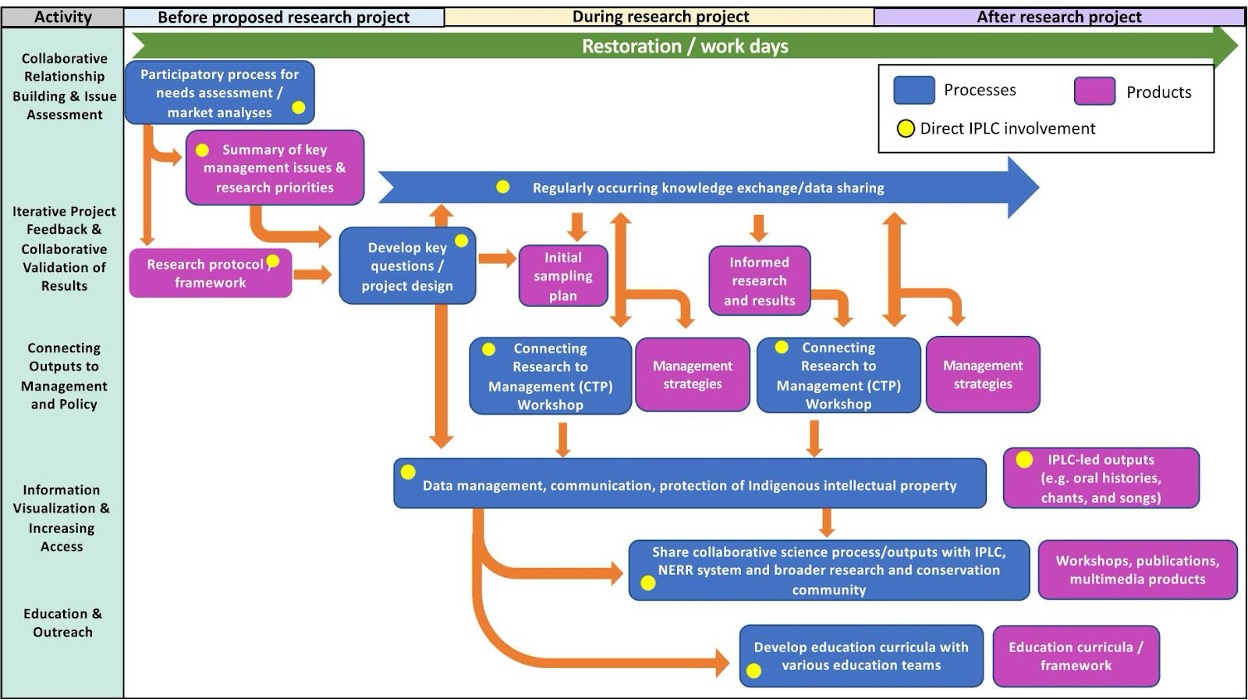
Fig. from Winter et al. 2020, showing Heʻeia NERR reciprocal collaboration process
Guiding principles for a research framework centered on reciprocal collaboration a fundamental goal of the Heʻeia NERR is to engage in reciprocal collaboration with the IPLC of the Koʻolaupoko region in a manner that equitably benefits both the community and researchers by recognizing and seeking to correct power disparities. Such an approach necessitates a pono framework for engaging in collaborative management and conducting collaborative research (Berkes 2009c, Bennett et al. 2019) within the designated boundaries of Heʻeia NERR (Fig. 1) and within the larger region of Koʻolaupoko. In this regard, research conducted within and/or otherwise supported by the Heʻeia NERR should align with the priorities of the IPLC, and it should operate within a process deemed pono by the community. The Heʻeia NERR’s framework for reciprocal collaboration, therefore, is built on a fundamental question and consists of a set of guiding principles for collaborative endeavors between researchers and IPLCs. This framework includes a list of research priorities identified by the community (see our reciprocal collaboration process for researchers and IPLC before, during, and after a proposed research project.
Equally important are culturally attuned processes of acquiring free and informed consent prior to initiating research projects (cf. FAO 2016, Kūlana Noiʻi Working Group 2018). A general framework for research standards in Hawaiʻi, “Kūlana Noiʻi” (Kūlana Noiʻi Working Group 2018), was developed through a partnership led by the University of Hawaiʻi Sea Grant College Program and Kuaʻāina Ulu ʻAuamo (KUA), in consultation with Paepae o Heʻeia and the Heʻeia NERR. The Kūlana Noiʻi provides guidance for building and sustaining reciprocal collaborations and long-term relationships between researchers and IPLCs. The standards articulated therein are intended to be flexible guidelines adaptable to a range of different communities and to reflect the perspectives and responsibilities of both researchers and communities in the context of equitable and mutually beneficial research partnership. The Kūlana Noiʻi calls for researchers to engage with the community of their study area early and often in the research process. The framework for approaching (both proposing and conducting) research in the Heʻeia NERR (Fig. 2), as modeled by initial research conducted therein (Bremer et al. 2018a, Möhlenkamp et al. 2019, Winter et al. 2020a; Box 1) builds off the Kūlana Noiʻi guidance. The framework for reciprocal collaboration used in the Heʻeia NERR has four main guiding principles: (1) conducting culturally appropriate research; (2) collaboratively developing research; (3) collaboratively producing new knowledge; and (4) informing policy through sharing of collaboratively produced knowledge.
Research and Monitoring Activities (past and current)
Map-Based Research and Monitoring Database
The He‘eia NERR provides an opportunity for coordinated management of resources to collectively achieve not only local goals but the larger goals of NERRS. This He‘eia NERR management plan1 starts with “A Traditional and Contemporary Approach,” which seeks to integrate traditional knowledge of the ahupua‘a and contemporary scientific research, monitoring, and training. The placement of the Approach at the beginning of the management plan was deliberate to provide the reader and user of the management plan an understanding and appreciation of the connection between traditional knowledge and contemporary science and research as a model for a sustainable estuary.
The NERR System-Wide Monitoring Program (SWMP) will provide long-term data useful to the research conducted in the He‘eia NERR, including water quality, weather, habitat, and land-use data. The priority goal under Research and Monitoring is to promote contemporary research and traditional knowledge to increase our understanding of the effects of human activities and natural events (including climate change) to improve informed decision making affecting the He‘eia estuary and coastal resources. Considering and incorporating traditional knowledge will help to strengthen the research done in the He‘eia NERR by considering historical land use and manipulation, and its effects on the estuarine environment including the ecosystem services these activities provide. This goal is consistent with the State’s Coastal Zone Management’s ORMP Priority 1: “Connecting Land and Sea.” The ORMP’s priorities are aligned with NOAA’s priorities. Additionally the NOAA-funded Science Collaborative competitive grant program integrates science end-users into the research process. He‘eia NERR staff, supported by HIMB, will support relevant research and ensure researchers are aware of relevant traditional knowledge resources that may complement their research projects. Linking research products to end users is another role the He‘eia NERR staff will play.
Geographic Scope of the He‘eia NERR Research Program
The research and monitoring program in the He‘eia NERR encompasses a majority of the He‘eia ahupuaʻa (Reserve Strategic Plan Obj. 1 Strategy f), with major focus on the lower regions within the NERR boundaries. Heʻeia NERR serves to facilitate all scientific investigations conducted within Heʻeia NERR boundaries (and beyond if applicable) to minimize duplication of research and ensure that research serves the needs and interest of co-management partners. Our current and ongoing monitoring sites, including select past sites, are being catalogued through a map-based research and monitoring database.
NERRS System-Wide Monitoring Program (SWMP)
Our long-term NERRS monitoring program consists of four official SWMP sites in the He‘eia ahupua‘a. The overall goal is to track the physical and biogeochemical parameters of the He‘eia Stream water that originates in our upper areas of the ahupuaʻa, and flows through invasive wetland vegetation, areas undergoing invasive mangrove removal, and restored lo‘i areas, and finally into He‘eia Fishpond and Kāne‘ohe Bay. The four SWMP sites are intended to measure various parameters in real-time representing the emerging wetland/tidal marsh, estuary, coastal/ocean interface, and patch reef in the Bay (Figure 28). This indicates a gradient in salinity, temperature, and land-use change. SWMP sites were designated to be able to track short- and long-term changes in the Heʻeia ahupuaʻa during active restoration of habitat using a combination of conventional and Indigenous Native Hawaiian management strategies. They were decided on through several meetings with co-management partners and other stakeholders to determine the best possible sites that synergized with on-going restoration, phase I of which is the removal of mangroves and other invasive biota, as well as future goals of restoring abundance. As a measure of success, we hope to be able to capture the return to conditions ideal for many of our native species (fish, waterbirds, invertebrates, etc.) that have not been seen in Heʻeia ahupuaʻa for decades since the arrival of invasive species. We also envision the SWMP stations to serve as data hubs for researchers with various expertise to conduct question-specific research based around our consistent SWMP water quality measurements.
Collaborative Monitoring and Research Projects
In addition to SWMP, He‘eia NERR collaborates with various research groups to conduct relevant experiments to address priority research areas, and to monitor other abiotic and biotic parameters within the He‘eia ahupuaʻa (Reserve Strategic Plan Obj. 2 Strategy a). To strengthen collaborations with academic researchers with specific expertise for the pursuit of identified research priorities, Heʻeia NERR aims to support one- to two-year graduate research assistantships (GA), when funds allow. Heʻeia NERR GA’s, therefore, conduct research tailored to address our research priorities, while gaining place-based training in reciprocal researcher-community relationships and Indigenous resource management and stewardship. He‘eia NERR encourages GA’s, their faculty mentors, and other collaborators to participate in the tenets of the Kūlana Noi‘i, and build relationships through various ways such as the twice-monthly Laulima workdays, where we gather to lend our hands towards restoration efforts with our co- management partners.
Publications and Online Bibliography
The complete collection of resources is available on Zotero.
Research Facilities
HIMB
As part of UHM, is the managing state partner for the He‘eia NERR program. The He‘eia NERR partners with a diverse group of HIMB researchers, educators, and specialists through collaborative research projects, workshops, and initiatives.
HIMB is a world-class center for research on tropical marine ecosystems (HIMB Strategic Plan 2010). Located on Moku o Lo‘e in Kāne‘ohe Bay, HIMB is surrounded by 64 acres of coral reef designated by the State of Hawai‘i as the Hawai‘i Marine Laboratory Refuge which is used for research activities only. HIMB offers cutting edge research facilities for faculty, students, and visiting scientists. Research that HIMB is conducting in Kāne‘ohe Bay covers a broad range of topics, such as coral bleaching and disease, symbiosis, ocean acidification, marine microbial ecology, fisheries and top predator research, aquaculture and fish physiology, and biogeochemistry and biophysical analysis of reef systems. Currently, Heʻeia NERR and its main staff occupy an office, meeting space, and shared laboratory facilities on Moku o Loʻe. HIMB is also equipped with ready access to the nearby coral reefs through a fleet of research vessels and a diving safety program, and provides additional infrastructure such as a mechanical shop, and administrative and IT services.
Kāko‘o ‘Ōiwi and Paepae o Heʻeia
Kāko‘o ‘Ōiwi and Paepae o Heʻeia are major co-management partners in the He‘eia NERR, and work to restore and perpetuate Indigenous resource management strategies. We work in conjunction with Kāko‘o ʻŌiwi and Paepae o Heʻeia staff to address identified needs through the research and monitoring program. Kākoʻo ʻŌiwi and Paepae o Heʻeia provide secure access to Heʻeia stream, wetlands, loʻi, and fishpond. In addition, knowledge and data sharing meetings can be conducted at indoor and outdoor meeting spaces at Kākoʻo ʻŌiwi, Paepae o Heʻeia, and at Koʻolaupoko Hawaiian Civic Club offices.